Cost Effectiveness 
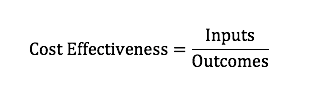
A measure of the relationship between inputs and outcomes.
The cost of producing a defined product or service, using for example, performance indicators, benchmarks, or unit ratios, and related to one or more other product or service to enable a comparison to be made.
Inputs will typically be maintenance costs, possibly being split between direct ones for which a manager is responsible and accountable, and also indirect costs but these are often outside the control of a manager so it may not be appropriate to use indirect costs in any form of performance measure.
To provide a fuller picture of cost-effectiveness, the construction or capital costs of a project may also be considered.
Inputs will typically be maintenance costs, possibly being split between direct ones for which a manager is responsible and accountable, and also indirect costs but these are often outside the control of a manager so it may not be appropriate to use indirect costs in any form of performance measure.
To provide a fuller picture of cost-effectiveness, the construction or capital costs of a project may also be considered.
Outcomes could be quite variable and extensive, depending upon the context of what is being measured, with examples being:
• Quality standard achieved.
• Number of games played.
• Number of users accommodated.
• Customer satisfaction indicator.
• Income generated.
• Profit made.
• How few injuries have occurred?
• Value for money indicator.
• CO2 equivalent emissions.
Many of the relationships will provide absolute values, for example, Cost per game, whilst others will provide relative, or intrinsic, values, such as a value for money indicator.
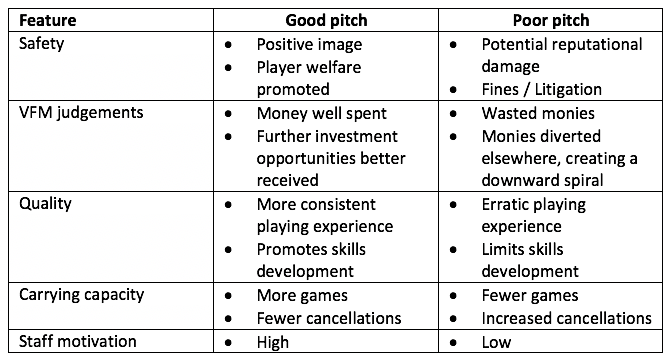
Implications and considerations for managing pitches cost-effectively: