Bill of Quantities 
An itemised list of resources which are required for a particular task.
This is usually used for a construction or maintenance specification and to summarise resources for a work programme. The resources might include material quantities, labour inputs (e.g. hours), equipment, and related costings.
Typically, an item within a bill of quantities will have a unit (such as a m2) and total quantity (such as 2,000) and if it is a tender document then a column for a price to be given against the item and quantity.
Benefits of including a bill of quantities include having a ready comparison document available for different tenderers; an open and transparent interpretation of quantities required for works, especially where these have been summarised from other documents and specification drawings; making it potentially easier to identify if a feature has been missed off the requirement; if values or obviously too high or too low from a typing error; errors have been included due to incorrect calculations; questioning returns made by a tenderer to clarify full meaning of the item being valued.
A bill of quantities can also be used to determine a rate for work (a schedule of rates) which is required for the same type of work, which is found to be needed whilst work is progressing, in addition to those stated: This is typically called a work variation or variation of work, or similar.
A typical Bill of Quantities sheet for a tender document will consist of many rows and might be laid out as follows:
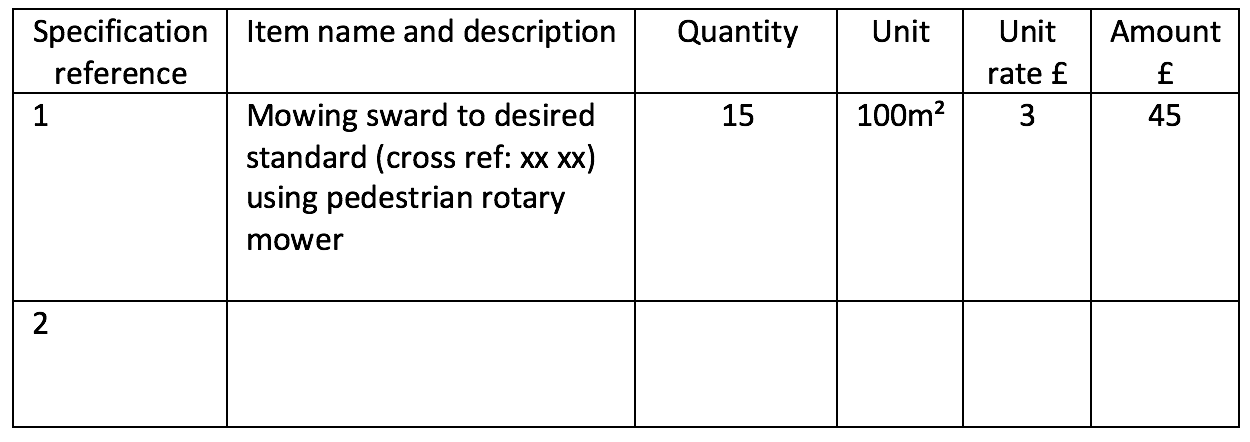
Note: Item 1: The quantity is multiples of the unit quoted, so the total area to be mown is 1,500m2.
The unit rate might be further split into two columns identifying material rate and staff/labour rate.